

Wallabag API
Python API for Wallabag v2.2.3
Requirements
- aiohttp
Installation
to get the project, from your virtualenv, do :
git clone https://git.gasser.ovh/thib8956/wallabag-api-client
or
pip install git+https://git.gasser.ovh/thib8956/wallabag-api-client.git
Creating a post
- request the token, if you don't have it yet
- create the post
#!/usr/bin/env python

import aiohttp
import asyncio

from wallabag_api.wallabag import Wallabag
# settings
my_host = 'http://localhost:8080'


async def main(loop):

    params = {'username': 'foxmask',
              'password': 'mypass',
              'client_id': 'myid',
              'client_secret': 'mysecret',
              'extension': 'pdf'}

    # get a new token
    token = await Wallabag.get_token(host=my_host, **params)

    # initializing
    async with aiohttp.ClientSession(loop=loop) as session:
        wall = Wallabag(host=my_host,
                        client_secret=params.get('client_secret'),
                        client_id=params.get('client_id'),
                        token=token,
                        extension=params['extension'],
                        aio_sess=session)

        url = 'https://foxmask.trigger-happy.eu'
        title = 'foxmask\'s  blog'

        await wall.post_entries(url, title, '', 0, 0)

        url = 'https://trigger-happy.eu'
        title = 'Project TrigerHappy'

        await wall.post_entries(url, title, '', 0, 0)

        # get all the articles
        my_wallabag = await wall.get_entries()

        all_article = my_wallabag['_embedded']['items']

        for article in all_article:
            print(article['id'], article['title'])

        # get the version of wallabag
        version = await wall.version
        print(f"version {version}")

        # export one article into PDF
        my_wallabag = await wall.get_entry_export(entry=1)
        with open("foobar.pdf", "wb") as f:
            f.write(my_wallabag)

if __name__ == '__main__':
    loop = asyncio.get_event_loop()
    loop.run_until_complete(main(loop))
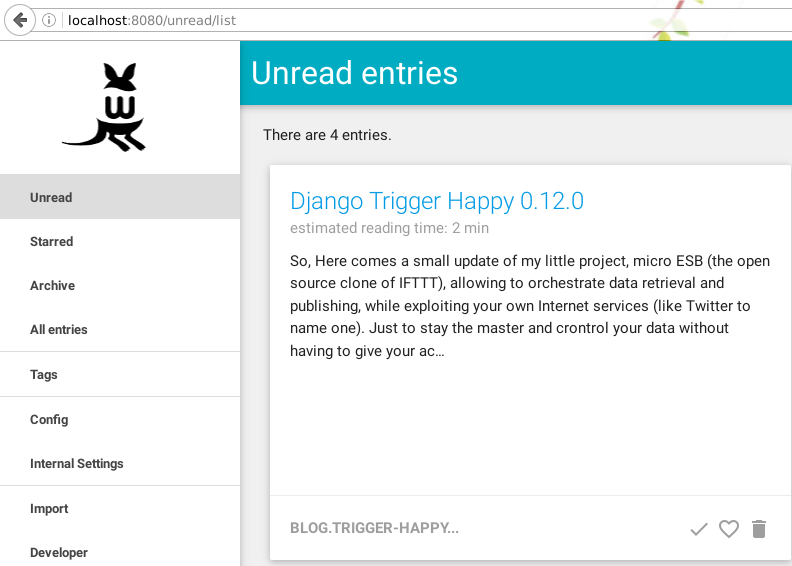
this will give you something like this :
Testing
Install Wallabag V2 on your own host like explain here http://doc.wallabag.org/en/v2/user/installation.html
Then run the development version (with make run)
Then create a client API like explain here http://doc.wallabag.org/en/v2/developer/api.html
this will give you something like this
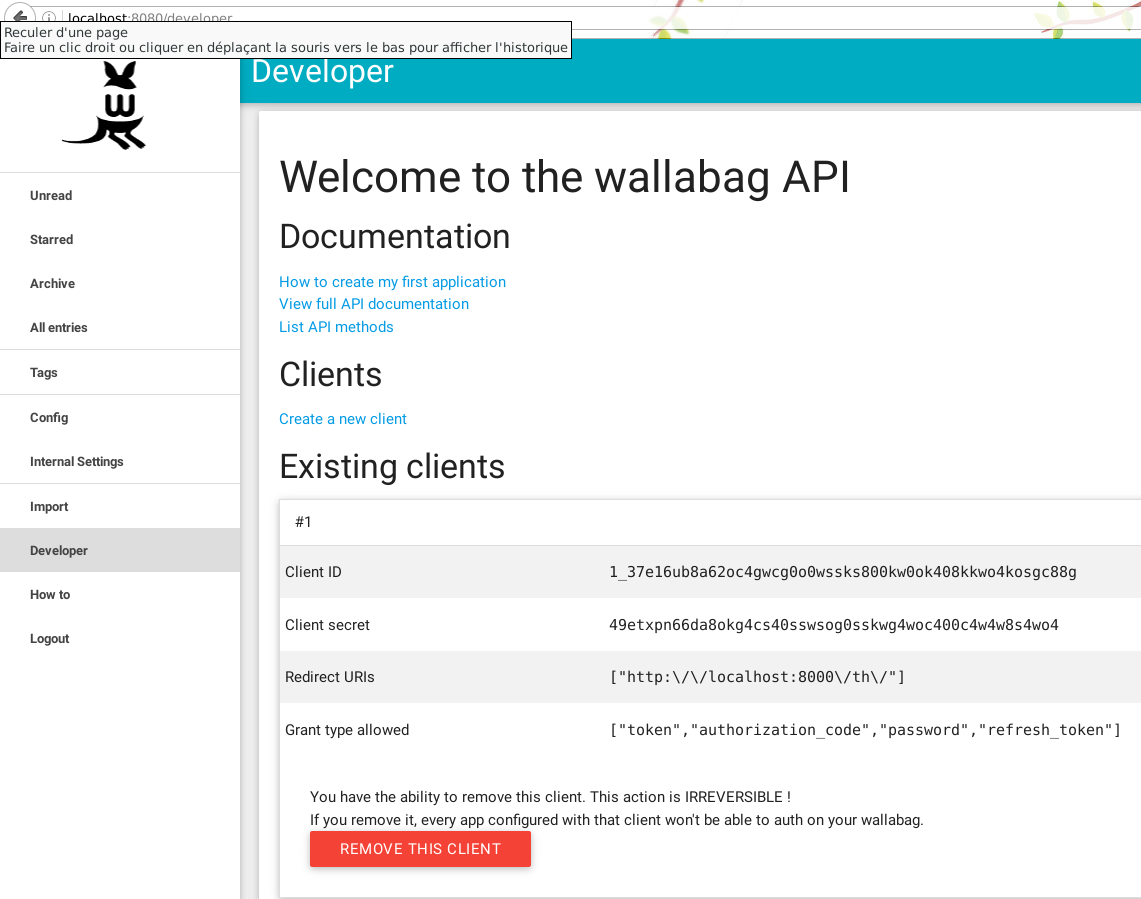
Then replace the client_id / client_secret / login / pass to wallabag_test.py and run
python wallabag_test.py